
Chapter 2: Building the support ecosystem for Open Education
Marta Bustillo and Sylvia Moes
Reviewers: Maura Flynn, David Stöllger
Keywords: Open education, OER, support, resources, funding, infrastructure, continuous professional development, universal design for learning, UDL, promotion, communication
UNESCO OER Recommendation areas:
(i) building capacity of stakeholders to create, access, re-use, adapt and redistribute OER
(iii) encouraging inclusive and equitable quality OER;
(iv) nurturing the creation of sustainability models for OER;
Target audience: Librarians, policymakers, managers, library ICT specialists, etc.
Before you dive into the chapter
This chapter explores the support structures and resources that enable Open Education initiatives to develop and become sustainable within higher education institutions. As you move through the chapter, you will encounter approaches and practical resources related to funding, infrastructure, dedicated staff, professional development, equitable access, and awareness raising. These can help you reflect on the support already available in your own context, identify potential gaps, and consider where existing resources and approaches could be reused or adapted.
The Reused Resources featured in this chapter are collected in an appendix, where you can explore practical resources related to the chapter topics and consider how they might be reused or adapted in your own context.
The learning outcomes below provide an overview of what you should be able to take away from the chapter. At the end of the chapter, Key Takeaways summarise the central messages, while Questions to Consider invite you to reflect on what you have explored and connect it to your own professional, institutional, or educational context.
Learning outcomes
After reading this chapter, you will be able to:
- Identify the key support structures, funding, infrastructure, and expertise your library and wider institution require to develop and sustain Open Education.
- Analyse your own knowledge and skills gaps in Open Education and identify areas for further professional development.
- Select appropriate resources and professional development opportunities to strengthen your Open Education knowledge and skills.
- Assess the quality, accessibility, and inclusivity of OER, applying principles of Universal Design for Learning (UDL).
- Identify and apply strategies to raise awareness of Open Education and promote its adoption among teaching staff and other relevant stakeholders within your institution.
For usability and accessibility reasons, all links in this textbook open in the same browser tab. Tip: If you prefer to open a link in a new tab, right-click the link and select “Open link in new tab” (or use the equivalent option on your device).
Chapter 2 Introduction
Open Education initiatives require a wide range of interconnected forms of support to succeed, become embedded in institutional practices, and remain sustainable in the long term. While individual educators, librarians, or project teams can initiate valuable Open Education activities, moving from isolated initiatives towards more established practices requires an environment in which people, infrastructure, funding, expertise, and institutional support work together.
Funding and appropriate infrastructure are important foundations for creating, storing, sharing, discovering, and reusing Open Educational Resources (OER). However, technical infrastructure alone is not enough. Educators need access to guidance and expertise when creating, adapting, licensing, and sharing educational materials. Libraries and other support units can play an important role in providing this expertise, connecting different stakeholders, and helping to integrate Open Education into existing institutional services and practices. Dedicated staff and continuous professional development are therefore essential for building and maintaining the knowledge and skills needed to support Open Educational Practices (OEP).
At the same time, supporting Open Education means considering who can access, use, and benefit from openly available resources. Accessibility, inclusivity, multilingualism, and the ability to adapt resources to different educational, cultural, and technological contexts are important dimensions of equitable access to OER. Creating supportive conditions also requires awareness: educators need to know what OER are, understand their potential benefits, and feel confident finding, evaluating, using, adapting, creating, and sharing them.
These different dimensions are closely connected. Funding can enable infrastructure and dedicated roles; infrastructure can make resources easier to discover and reuse; professional development can build the expertise required to support educators; and communication and awareness raising can encourage wider participation. Sustainable Open Education therefore depends not on a single intervention, but on a combination of support structures that reinforce one another.
In this chapter, we explore six key strategic areas that can help institutions develop and strengthen this support environment. Alongside the discussion of each area, we point readers towards existing resources, examples, and approaches that can support further learning and provide starting points for reuse and adaptation in different contexts.
This chapter will describe six key strategic areas that help Open Education initiatives succeed:
- Project funding and long-term funding
- Infrastructure to store OER
- Dedicated staff to lead OE initiatives
- Addressing staff skills gaps in libraries
- Equitable access to OER
- Raising teaching staff’s awareness of OER
Together, these six areas provide different perspectives on what is needed to move from individual Open Education activities towards more coordinated and sustainable institutional support. The following sections examine each area in greater detail and introduce resources that can help readers develop their knowledge, assess their own context, and identify approaches that may be reused or adapted to strengthen Open Education practice.
2.1 Project funding and long-term core funding to support sustainable OE initiatives
As we saw in Chapter 1, policies promoting and supporting Open Education, both at the institutional and at the national level, are key enablers to ensure the success of open educational initiatives. Crucially, they provide a strong rationale for requesting initial project funding and more long-term funding that can guarantee their sustainability into the future.
UNESCO’s Dubai Declaration on Open Educational Resources specifically mentions the importance of sustainable funding to make OER initiatives viable in the long term (UNESCO, 2024). However, very often such initiatives are funded by institutions, governments or philanthropic donors as pilot projects, without core funding to sustain them in the long term (Orr et al., 2015, pp. 113–114).
The transition from pilot project funding to core funding is at the heart of ensuring the viability of open education initiatives, and this transition is linked to the perceived value OER practices bring to individuals and communities within and across institutions. Creating high-quality resources which contribute to the common good and developing a large network of users, collaborators, and partners who support the resources will ensure their long-term sustainability (Stacey, 2023).
In order for OER projects to become sustainable at a local level, there must be a shared vision around open educational practices among institutional leaders, educators, learners, library staff, technical support services, and other stakeholders.
While Open Education champions are key to the development of an open pedagogy movement, national policy and support from public and private funders can provide long-term finance for OER. However, projects must be able to demonstrate their sustainability in order to receive long-term, core funding.
What follows is a set of strategies that can help ensure the sustainability of OER projects, resulting in the provision of long-term funding. They derive from (Rossum et al., 2025):
- Involve a diverse group of stakeholders (educators, learners, decision makers, policy makers, technical support staff, etc.) and give them active roles within the project. They will act as project champions and enhance the long-term sustainability of outputs.
- Ensure the OER you are creating responds to a specific institutional need.
- Start planning for long-term funding from internal or external sources before the project starts, and while it is taking place.
- Map your OER project to your institution’s strategic goals.
- Integrate the OER into existing courses, either as a unit or in modular form.
- Formalise ownership of the project, either through individuals or through educational partnerships.
- Join (or create) a Community of Practice and use it as a platform for sharing the OER.
- Work with the Library and ICT department in your institution to establish OER management, maintenance and preservation strategies for the future.
- Use existing institutional/national infrastructure whenever possible.
- Share your OER using established open platforms such as GitHub, for automatic updates and version management.
Nevertheless, even when applying these strategies, long-term funding for OER initiatives remains a continuing challenge at the institutional, national, and international levels. It is ultimately linked to a more holistic approach to open educational practices, which combines grassroots communities of practice, high-quality outputs, accreditation and recognition mechanisms for practitioners, and supportive policy with sustainable funding from institutions or national and international funders.
To find out more about long-term funding and sustainability of OER projects, please check the following resources – also to be found in the appendix of reused resources with more description available:
- Reused resource 1: Open Education Café. Nurturing the creation of sustainability models for OER.
- Reused resource 2: Sustainability strategies for open educational resources: Creating lasting value and cultivating adoption
2.2 Infrastructure to store OER and make them available/ accessible for re-use
Language and Localisation: The need for linguistic translation and adaptation of OER to ensure accessibility is emphasised.
Collaborative Ecosystems: A collaborative ecosystem must be developed, wherein various stakeholders—including educators, institutions, and learners—cooperate and share responsibility for OER sustainability. This ensures ownership and collective investment in resources.
Introduction to storing and sharing OER
Sharing OER can be done in a very simple or a more complex manner. The OER sharing model depends on the context, the stage of development and the financial resources of the individual, organisation or network of experts collaborating in a specific domain. The good news is that everyone has the possibility to share OER if they have a computer and an internet connection.
Sharing OER without an institutional platform
If an individual is the owner of a learning material and would like to start sharing it, but there is no OER support in their institution or on a national level, they can use international platforms like Merlot or OER commons. They just need to create an account and start the process of sharing their OER. With small OER, this is not very complicated. Producing big OER-like courses and open interactive textbooks requires better infrastructure, e.g., an online environment that guides students to the content and learning activities.
If the institution is the owner of the learning materials (i.e. the staff member created these while working for the institution), the staff member must ask permission to share the learning materials openly, and check whether the institution has made a choice on the specific type of Creative Commons license they support (see below).
In any situation, be it small OER (picture, presentation, video/audio) or big OER (courses, lessons, open textbooks), everyone who shares OER needs to pay attention to the ownership of the content that is shared. Regardless of whether an individual or organisation is the creator of learning materials, a Creative Commons (CC) license is added to the content and as part of the metadata, to make clear how other people may use the learning material(s). The infographic below shows different types of CC licences and their permissions.

When an individual or organisation wants to reuse third-party content in their learning materials, they must ensure that re-use is allowed and that these materials are free of copyright and shared via a Creative Commons license. There are different platforms to find open content. Robert Schuwer’s website is a good starting point.
Check out the Creative Commons licenses website for more information.
Re-usable formats
The optimal way of sharing content as OER is in a format that allows others to reuse it or edit the material to their own needs. PDF, for example, is a format that allows users to read the content, but editing it is more difficult. An open document format is a good example that facilitates re-use.
Metadata to make OER findable
Quality metadata makes OER findable and easy to share (see below examples of metadata standards to make OER findable on different platforms.
What is quality metadata? These are the key elements:
- Title that gives a clear idea of the learning object.
Example: Newton’s First Law: Interactive Simulation for Secondary Education - Subtitle: A subtitle gives extra information on the title, and can (sometimes) be helpful.
- Summary/description that explains how the content should be used to support students in achieving their learning goals/outcomes.
Example: This interactive simulation is designed for first-year bachelor students in physics or engineering programmes.
It introduces Newton’s First Law of Motion through digital experimentation, allowing students to manipulate variables such as friction, force, and mass to observe their effects on motion. The activity supports conceptual understanding and application of inertia in real-world systems. It is suitable for blended or flipped learning formats, and includes instructor guidance and discussion prompts to foster analytical thinking.
- Keywords.
Example: Newton’s First Law, classical mechanics, inertia, physics simulation, undergraduate physics, flipped classroom, active learning - Academic level bachelor, master, etc.
- Discipline arts, business, education, health sciences, humanities, etc.
- Intended end user is this material designed to help other educators or is it for me and for students?
- Language of the learning material(s).
- Aggregation level: course, lesson, learning object, fragment.
- Type of material – technical format.
- Learning resource type e.g., Simulation, Conceptual Activity, Guided Experiment
- Name(s) of authors and publisher (institution).
- Publication date in a standardised version dd/mm/year, mm/dd/year, year/mm/dd.
- LifeCycle – version & status (final, concept).
- Reuse permissions – CC license, (or other open license).
Sharing OER in communities
After describing how OERs can be easily shared without institutional or national options, we will now take a closer look at how OERs can be shared in, say, a collaborative environment. This situation does require facilities such as a repository for unlocking OER and a platform on which these learning materials can be made findable for communities. For this, a choice can be made between setting something up oneself (institution/community) or joining existing initiatives such as Merlot.org (See screenshot below). On the Merlot website, detailed information is available on how to share OER after you or your institution becomes a member. Merlot created a Youtube channel with tutorials.

Controlled vocabularies
Although not yet common, a deeper look at controlled vocabularies is interesting. A controlled vocabulary is a shared jargon within a field of study or training, based on related professional skills or terms and is by definition cross-institutional.
It is usually set up as a plain list or hierarchical structures of terms (most often as a spreadsheet), to be published as a linked dataset via an API, when it has its final destination.
There are two different types of professional vocabularies:
- Competence-based: this professional vocabulary has a taxonomy structure based on competencies. The competencies are always based on professional practice (an occupational profile) and sometimes in addition to education (a programme profile, like information literacy or nursing).
- Based on subject content, this professional vocabulary has a taxonomy structure consisting of a hierarchy of concepts from a particular field (e.g., anatomy).
In the Netherlands, SURF is supporting communities to set up a controlled vocabulary and help to publish their learning materials. When the vocabulary is published as linked data, it will be integrated into a portal for learning materials, so everyone can filter via fixed-structure learning materials for certain learning outcomes. To achieve that, the elements of the vocabulary must be added to the metadata. SURF integrated vocabularies for that reason in SURFsharekit, a repository to describe and publish OER. See this guideline that they published on how to create a controlled vocabulary.
Added value of controlled vocabularies:
- Because institutions and communities work together to set up a controlled vocabulary, there is consensus on the way in which learning materials should be published related to learning outcomes.
- It helps in the reuse of OER. Staff work together to share and create.
- It costs less time to find OER for specific learning outcomes.
- There is less contamination in the metadata because standardised lists with terms (proven by the community) become available in the repository as a structured set to enrich metadata on a level of a specific domain or discipline (see screenshot below).
- Communities have a good overview of how many learning materials are available for certain outcomes.

In order to filter by vocabulary, integration of the linked data set in a repository is needed to share OER. The vocabulary is part of the metadata and helps to make it findable, as above, in a platform for OER. The elements that have been selected become part of the metadata (see screenshot below as an example for nursing – in Dutch – it is a mirror of the set above).

Making OER findable via Metadata standards
Using metadata standards, we can not only share and find OER on a specific platform, but we also have the possibility to make the metadata machine-readable to publish it on other platforms. OER Commons is a great example of that. They have 255 providers (July 2026) that made their curated collections searchable via OER Commons.

There are different metadata standards to describe OER, and make them searchable via a method called “Federated search”. Metadata standards to support this are, for example, IEEE-LOM, DCMI Metadata Terms and LRMI (Learning Resource Metadata Initiative).
Besides these 3 standards there is also a possibility to share OER via schema.org. Schema.org is giving the possibility to add more information on location info. For example “exursions” via “education event” in combination with “GeoCoordinates”.
OERSI is a portal based on federated search in Germany (DACH-region), utilizing the General Metadata Profile for Educational Resources based on schema.org/LRMI-based profile. See for more information: OERSI FAQ
All these standards are compatible with OAI/PMH, for example, so that the metadata is machine-readable to make OER findable on different platforms.

Below you will find an overview of how a mapping is created between IEEE-LOM, DCMI and LRMI. Based on the most common standards for sharing and publishing OER. Of course, other mappings are possible. This is just to give an idea of the possibilities for interoperability amongst platforms.
| Metadata Element | IEEE-LOM | DCMI Metadata Terms | LRMI (Schema.org) | Description |
|---|---|---|---|---|
| Title | General.Title | dc:title | name | Title of the learning object, or lesson |
| Description | General.Description | dc:description | description | Summary |
| Creator / Author | LifeCycle.Contribute (role: author) | dc:creator | creator, author | Person or entity who created it |
| Contributor | LifeCycle.Contribute | dc:contributor | contributor | Others who contributed |
| Publisher | LifeCycle.Contribute (role: publisher) | dc:publisher | publisher | Who made it available |
| Date | LifeCycle.Date | dc:date | datePublished, dateCreated | Important dates |
| Subject / Keywords | General.Keyword | dc:subject | about, keywords | Topics or tags |
| Language | General.Language | dc:language | inLanguage | Language of the resource |
| Format | Technical.Format | dc:format | encodingFormat | File type or technical format |
| Identifier | General.Identifier | dc:identifier | identifier, url | Unique ID (e.g., DOI, URI) |
| Educational Level | Educational.Description / Context | audienceEducationLevel | educationalLevel | Intended audience level |
| Learning Resource Type | Educational.LearningResourceType | learningResourceType | learningResourceType | Type (e.g., simulation, video) |
| Interactivity Type | Educational.InteractivityType | — | interactivityType(LRMI extension) | Passive or active learning |
| Interactivity Level | Educational.InteractivityLevel | — | interactivityLevel(LRMI extension) | Low to high interactivity |
| Typical Learning Time | Educational.TypicalLearningTime | — | timeRequired (LRMI extension) | Estimated study duration |
| Rights | Rights.Description / Cost / Copyright | dc:rights | license, copyrightHolder, isAccessibleForFree | Usage rights and access |
| Access Rights | — | accessRights | conditionsOfAccess | Who can access and under what terms |
| Audience | Educational.Description / Context | audience | educationalAudience | Target group |
Mapping metadata: Created & controlled by Sylvia Moes via ChatGPT
Side note:
- IEEE-LOM is more structured and hierarchical.
- DCMI is broad and widely used for general digital resources.
- LRMI is an extension of Schema.org, designed for web-based educational metadata.
- Some DCMI and LRMI elements don’t have exact IEEE-LOM equivalents and vice versa (e.g., interactivity levels are better defined in IEEE-LOM and LRMI than DCMI).
To help institutions to share OER via metadata standards, SURF created information on sharing OER. Elements below are based on the SURF guideline:
p.s. the steps below in this text are coming from SURF guideline, but you can think on other repositories as well, like OERSI or Merlot )
Table of Contents:
Part 1 Storing and sharing
- Storing and sharing of open educational resources
- Copyright release – providing the correct licence
- Storing in the right format
- Storing in a findable place
- Providing the right metadata
Part 2 Findability (is more specific for the Netherlands, but the method can be re-used when institutions/collaborations work with learning technology standards).
- Making open educational resources easier to find
- Connect your repository to edusources (via OAI/PHM)
- Creating of collections
A national OER Framework
Infrastructure is key in sharing and publishing OER, but the implementation on all steps needed to create, use and re-use OER are important as well. Paul Stacey created a model for this under the name “National OER framework”. Below more information about this framework.
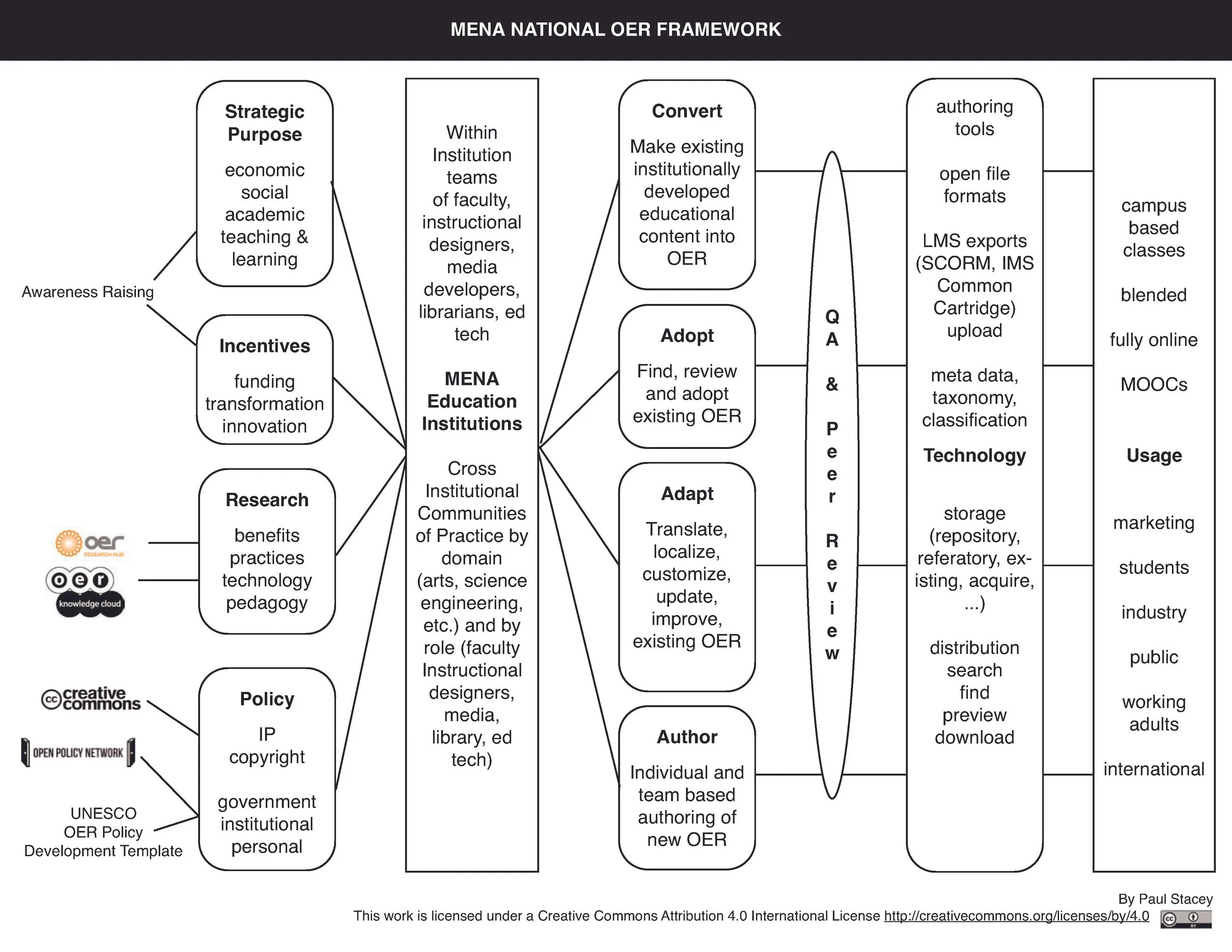
Above you see the framework that Paul Stacey developed to locate the position of technology in the whole infrastructure of OER. He was a guest during Open Mic: the ENOEL podcast on the UNESCO OER Recommendation. OE Bite: 4th area of action where he talks about this model.
https://youtube.com/watch?v=lqnqhf4T6oY%3Fsi%3DN8Fot9_n2cSVfF17
In this talk, he said, “In this diagram I try to show that there are many components to an OER initiative that have nothing to do with technology and come well before technology decisions need to be made” (Stacey 2023).
Below, a small introduction is given of the components of OER and the technical infrastructure in a broader perspective. The text below is extracted from his blog post.
(All the components below are worked out in more detail in other chapters of this textbook).
-
- Strategic purpose: OER initiatives should be strategic and purposeful.
- Incentives: to realise the transition and innovation.
- Research: evaluate practices’ outcomes.
- Policy: OER require policy by institutions to make it sustainable.
- Support via OER teams:
- Forming inter-disciplinary OER teams within an institution made up of faculty, instructional designers, media producers, librarians, and educational technologists. For OER to succeed, a team effort is needed, and each of these roles has crucial skills and knowledge to contribute.
- Forming communities of practice across all the institutions involved in a national OER initiative that brings together people across institutions by domain (such as arts, science, engineering, etc.) and by role (such as faculty, instructional designers, librarians, etc.)
- Publish, find, edit and re-use:
- Convert: First review existing curricula already developed and identify educational content that is desired, and search existing OER to see if anything is available.
- Adopt: If it is useful material for your education, adopt it.
- Adapt: When OER is found, but not a perfect fit, why not adapt it? – translate, localise, customise, update or improve the educational materials so that they fit.
- Author: Finally, as a last measure, having exhausted the previous three efforts, if OER is needed where none exists, then go ahead and author it.
- Quality Assurance (QA) & Peer review: OER should be vetted through a quality review process and peer review.
- Technology:
- Authoring tools to create and work together on the creation of content.
- Open file formats so others can modify the resource downstream.
- LMS exports: interoperability of OER so it can be exported out of one Learning Management System and uploaded to another.
- Storage: classification schema for OER (metadata standards).
- Distribution: repositories or referatories where OER can be found, previewed, and downloaded.
- Usage: OER are multi-use, on-campus courses, mixed or blended courses, fully online courses, and MOOCs. OER don’t just have teaching and learning value, but also are useful as marketing to students (try before you buy), they can help industry meet the professional development needs of their employees, and they help working adults pursue career pathways.
- Open file formats so others can modify the resource downstream
- LMS exports: interoperability of OER so it can be exported out of one Learning Management System and uploaded to another
- Storage: classification schema for OER (metadata standards).
- Distribution: repositories or referatories where OER can be found, previewed, and downloaded.
Domain architecture of SURF (as an example)
SURF’s domain architecture in the Netherlands is developed by the Education Exchange Platform (see picture below) to make OER interoperable, aligning with component 8 of Paul Stacey’s framework above.
The Education Exchange Platform helps to support institutions by making their OER available through concern systems (concern systems are, for example, Kaltura as a video platform and Pressbooks for open textbooks), which are used to create, for example, videos and open textbooks.
It also makes available OER in other (inter)national repositories interoperable, e.g., Europeana, OER Commons, MedPix and Directory of Open Access Books (DOAB). Content will be findable at the national repository for OER in the Netherlands, “edusources”, and using the infrastructure for specific communities of practice via a “white label portal” (see, for instance, this example.) Interoperability of content between edusources and editor platforms like Wikiwijs and Xerte is also covered.

Alignment with UNESCO OER Recommendation: The example above is making OER findable and interoperable in line with the national and international standards and open licensing, regarding the Recommendation on Open Educational Resources (OER) of UNESCO, especially area action IV: Nurturing the creation of sustainability models for OER.
Translation of OER
Translation converts educational content from one language to another, improving accessibility and supporting global learning.
Let’s remember that an OER is composed of text, visual and audio components, and translating visual components is usually a hard task. Because of this, the focus usually lies in translating the audio and text content. It is worth mentioning that just having captions in the students’ language improves comprehension also for users with non-native speaking capabilities.
That can be done in a workflow like this:
[Audio OER] -> [Automated transcription] -> [Captions] -> [Human Review] -> [Automated translation] -> [Human Review] -> [Translated captions]
The last part of this workflow may also be used for the translation of the text content of the OER.
The automated transcription will be made by an ASR (Audio Speech Recognition) tool. In recent years, there has been a constant improvement in the quality of the ASR tools, and they provide results comparable to a human operator in a fraction of the time.
When selecting an ASR tool, there are several points to consider:
- Quality: Usually, quality is measured with the WER (word error rate) metric, namely, the number of words not properly recognised. Due to this metric considering all the words equally and that there are more problems with the small particles, it is considered that any WER under 10% is like what a human would transcribe.
- Domain words: are the words specific to the topic of the OER, and it is of the utmost importance to be properly transcribed. If the tool doesn’t properly get the domain words, usually there are possibilities to fine-tune the ASR engine.
- Diversity: Not all speakers have the same dialect or linguistic phonetics, so a test with real-world users is a must.
At the time of writing, the most common tool for ASR is Whisper, since it comes with a very permissive MIT license. There are a lot of adaptations of Whisper to multiple languages, so it is the default tool to use. Organisations and end users may use Whisper in a local installation, preserving the privacy of the content.
Once the content is translated, there should be a human review before translation, since the quality of the translation is extremely impacted by any errors in the translation. This is especially important for the domain words, since they carry the most relevant information.
The task for the translation tool is to translate from one text stream, which may be in the form of captions, to another text stream in the desired language. As in the case of translation, there has been a constant improvement in the tools available with open licenses. Namely, the Opus project provides a full working state-of-the-art translation system for many languages, and the Hugging Face web page for translation systems provides many systems to use.
Once the content is translated, it should be human-reviewed again. For captions, an interface with parallel screens is often of great help. Subtitle Edit is an Open-Source tool with a GPL3 license that allows to do that parallel review.
In some cultural contexts, video dubbing is a proper practice. For those cases, we could add a text-to-speech (TTS) tool to our translation pipeline to dub the videos in a different language. Again, there are recent Open-Source tools up to the task, while this is a field that is still under heavy development. As of the time of writing, Kokoro TTS is MIT-licensed software that would be a good point to start.
The author of the text above on the translation of OER is Carlos Turro Ribalta/ Carlos is Head of Media Services and Network Administrator at Universidad Politécnica) and has been working for years on this topic at an international level. See an overview of his publications below for his work on this matter “Making content accessible: Translations of learning materials”.
Projects & Demos

Screenshot from https://www.mllp.upv.es/translectures-demos/ and https://www.mllp.upv.es/projects/translectures/
2.3 Dedicated staff to lead OE initiatives and support educators in the creation of OER
Open Education initiatives in academic institutions often start as pilot projects with one staff member supporting the creation of a small-scale open educational resource. Such projects allow the organisation to gauge the resourcing required for a more long-term Open Education support service, in which educators receive the guidance they need to transform their teaching materials into openly available OER.
Librarians often lead or are involved in such pilot projects, but they do this in addition to their other library duties. As a result, they often lack the capacity to act strategically, build relationships across the institution and influence policymakers to embed the necessary incentives to scale up open education initiatives.
On the other hand, dedicated library staff for OE initiatives can focus on the relationship building necessary to encourage grass-roots communities of OER creators, as well as engaging policymakers in the development of lasting OE policies. Such dedicated staff often provide the following:
- Advice on reliable sources of OER for specific disciplines.
- Support in the adaptation, re-use or remix of existing OER.
- Project-planning support for the creation of new OER (textbooks, interactive tutorials, videos and more.)
- Promotion and dissemination of OER created at the institution.
- Collaboration in OE policy development with stakeholders across the institution.
- Implementation of objectives and action plans in co-created OE policies.
However, in the absence of dedicated staff to lead OE initiatives, librarians can still provide support to anyone interested in applying open educational practices in their teaching, particularly around the areas of searching for existing quality OER and open licensing. Yet, these approaches, while helpful, lack the institutional (and often national) reach necessary to embed OE practices more widely.
2.4 Addressing staff skills gaps in libraries to support OE practices/ initiatives
Both the Paris 2012 OER Declaration (UNESCO, 2012) and the 2019 guidelines on OER (UNESCO & Commonwealth of Learning, 2019) highlight capacity building among key stakeholders as a key activity to support the development of a global open education ecosystem. SPARC, Europe’s most recent survey of European higher education libraries, carried out in 2023, reveals that academic librarians provide a variety of services to support open education, ranging from metadata and collection management to intellectual property and licensing advice, OER discovery and information literacy training covering the principles of open education (Treadway et al., 2024). Most of these services are closely related to the core professional skills of librarians. However, while library staff are considered key stakeholders in the development of OER policies (UNESCO & Commonwealth of Learning, 2019), some of the skills necessary to support open education are still not officially taught in Library and Information Science professional programmes (Santos-Hermosa, Gema & Atenas, Javiera, 2022). Therefore, the involvement of librarians in the promotion of open education practices, the development and implementation of open education policies and the co-creation of OER requires capacity building by libraries to address specific skills gaps.
Key among the identified skills gaps are copyright and licensing knowledge (Thompson & Muir, 2019), awareness raising and community building around open educational practices, and participation in policy development.
Today’s librarians are an adaptable lot: they are used to constantly learning new skills and having to keep up with major technological changes. Nevertheless, while some skills gaps, such as copyright and licensing knowledge, are still closely related to core professional skills, others require a focused effort in capability building by library managers and others in the wider institution. This chapter will explore the skills gaps mentioned above and propose some professional development solutions.
Skills gap: Copyright and licensing knowledge
UNESCO’s Dubai Declaration on Open Educational Resources (UNESCO, 2024a) specifically states that providing professional development for educators and content creators on copyright and open licensing issues is key to navigating the challenges posed by emerging technologies such as AI. In the Open Education ecosystem, librarians are likely to provide services that support educators in their OE journey, or to be OER content creators themselves. Copyright queries from educators are often the initial point of contact for librarians delivering open education support services.
As OER are reused and updated, a clear understanding of the conditions under which specific open licenses can be used is crucial, particularly if some of the content has been created with the aid of AI tools. Yet librarians very often acquire this skill ‘on the job’, rather than through formal educational avenues.
There are a number of highly reputable open online resources that can help librarians develop more in-depth knowledge of copyright and open licensing. A good example is this resource by Ireland’s National Forum for the Enhancement of Teaching and Learning: Using OER and OEP for Teaching and Learning (National Forum for the Enhancement of Teaching and Learning in Higher Education, 2021). Sections 2 and 3 of this chapter have specific information about copyright and licensing.
However, it is often useful to attend either online or in-person live group training in order to attain a deeper level of understanding in collaboration with colleagues from other institutions. Library consortia, professional organisations and communities of practice such as the ENOEL play a pivotal role in helping librarians develop copyright and licensing skills by offering workshops delivered by expert practitioners.
For more in-depth information about the legal complexities of reusing OER, please visit Chapter 4, OE Practices.
Skills gap: Awareness raising and community building
The sustainability of OER resources is often determined by the strength of the community of users and OE partners who share, reuse, and support each resource. In such an environment, community building becomes a key skill in the open education practitioner’s arsenal.
Identifying potential partnerships within and outside the institution is an essential process to raise awareness and build a community around open educational practices. The Social Interoperability model developed by OCLC in relation to research support (Bryant et al., 2025) is a useful starting point to understand this process.
The model considers universities as ‘complex adaptive systems’ (Bryant et al., 2025, p. 5), which display behaviours that can be challenging to the development of cross-institutional strategies. These include having no single point of control, conflicting goals between different areas, self-organisation, non-linear, dynamic behaviour, and independent learning agents.
The report mentions the central role the library plays as a trusted partner for sustainable services, not just short-term projects (Bryant et al., 2025, p. 24). It also maps potential stakeholders for research support, which are equally relevant to library-based open education initiatives. They include the university’s Academic Affairs unit, ICT Services, Faculty Affairs and Governance, and the Communications unit:

The key to working effectively with these potential stakeholders is to identify their campus-wide strategic interests, incentives and potential inhibitors to collaboration, while also articulating clearly the library’s expertise and value in the implementation of the proposed service: “The essential first step in building successful campus partnerships is to know your partners – what they do, what they prioritize, and how they see themselves contributing to the university mission.” (Bryant et al., 2025, p. 15)
Once stakeholders have been identified, targeted awareness-raising strategies need to be developed. Campaigns may be linked to international events such as Open Education Week or the OE Global Conference, which can be used as starting points for context-relevant training or communication about OE practices for the various stakeholder communities. For instance, different strategies should be used when addressing educators who want to learn about practical strategies for creating OER, or when targeting institutional managers about the development of OER-supportive institutional policies. Above all, it is important to articulate clearly how collaborating with the library in an open education initiative will further the stakeholders’ own strategic goals.
A number of resources have already been created to help librarians promote the benefits of open education to various stakeholder groups, including the Open Education Benefits ENOEL Toolkit (Reused resource 7). Such promotion can take different shapes, from poster campaigns to training workshops or presentations to relevant institutional bodies. Resources should be reused and adapted to each local context.
Skills gap: Participation in policy development
Of all the skills gaps identified above, participation in policy development is perhaps the most difficult to address for librarians. As seen in chapter 1, open education initiatives cannot thrive without supportive policy at local, national or even international level, yet traditionally, policy development has not been a core role of librarians.
Open Education Policy development works well as a co-creation process in which key stakeholders not only have a voice, but direct input in its creation (Atenas et al., 2020). Librarians, as key stakeholders in OER creation and dissemination, have much to contribute to policy development.
UNESCO’s “Guidelines on the Development of Open Educational Resources Policies” (UNESCO & Commonwealth of Learning, 2019) identify a seven-phase policy development process which incorporates the following steps:
- Understanding the potential of OER
- Determining the OER vision
- Framing the OER policy
- Executing a gap analysis
- Designing the masterplan
- Planning for governance and implementation
- Launching the OER policy (monitoring and improvement)
Librarian skill sets, such as an understanding of the scholarly communications landscape, skills in curating disciplinary collections and knowledge of copyright and licensing, are particularly well-suited to understanding and communicating the potential of OER. They also provide a context to policy creation, contributing to an OER vision that addresses some of the educational challenges identified in SDG 4. However, other aspects of the policy development cycle may be less familiar.
The UNESCO guidelines consider librarians as key partners for capacity building and awareness raising around OER. They are also mentioned in relation to governance and implementation of the policy, participating in coordinating bodies that support the implementation of specific interventions and facilitating collaboration between the various stakeholders and OER users.
In short, librarians have the skill set necessary to participate in policy co-creation, or can develop those skills through targeted professional development. More information about open education policy co-creation can be found in Atenas et al. (2020).
To find out more about addressing staff skills gaps, check out the following resources – – also to be found in the appendix of reused resources with more description available::
- Reused resource 5: Open Education Librarianship: A Learning Path
- Reused resource 6: ENOEL WS#7 – Embrace the Open: Sharing OER [recording]
- Reused resource 14: ENOEL WS#1 – Embrace the Open: An introduction to Open Textbooks
- Reused resource 15: ENOEL WS#10 – Embrace the Open: Advocating for Open Education through its own tools
2.5 Equitable access to high-quality, inclusive, multilingual OER
The Open Education movement relies heavily on digital technologies for effective knowledge sharing, which makes digital OER inherently inaccessible to a large percentage of the world’s population. Energy insecurity, inadequate information technology infrastructure and lack of funding for necessary hardware and software place access to the simplest OER beyond the reach of many citizens in the Global South. In addition, technologies are never neutral: their design and organisation impose an overwhelmingly Western epistemological bias, often favouring English as the lingua franca and excluding non-Western approaches to knowledge dissemination from the digital environment. Web technologies can also create significant barriers to accessing knowledge for persons with disabilities.
However, there are open educational practices that can mitigate these inequalities. Let’s examine now some practical approaches that will help with the creation of equitable, high-quality OER.
UNESCO’s Guidelines on the Implementation of the OER Recommendation. Action Area 3: Effective, Inclusive and Equitable Access to Quality OER (UNESCO, 2024b) focuses on the following areas:
- Ensuring access to OER that meets the material needs of target learners and the educational objectives for which the OER is used, including ensuring offline access to OER where appropriate.
- Supporting the development of gender-sensitive, culturally and linguistically relevant OER, and the creation of OER in local and indigenous languages.
- Ensuring that the principle of gender equality, non-discrimination, accessibility, and inclusiveness is reflected in OER strategies and programmes.
- Supporting increased access to OER, particularly for low-income communities, through public investments and incentivising private investments in ICT infrastructure and broadband, as well as other mechanisms.
- Incentivising the development of research in OER.
- Developing and adapting existing evidence-based standards, benchmarks, and related criteria for OER that emphasise reviewing educational resources (both openly and non-openly licensed) for quality assurance.
In this section, we will focus on 1, 2, and 6 to provide practical strategies for creating OER.
Ensuring access to OER that meets the material needs of target learners
This consideration should be addressed at the planning stages of creating OER, and can encompass a number of practical actions, including the following:
- If using digital course authoring software, plan to also deliver the same content in open document formats, which allow the resource to be easily printed out for offline access. This will ensure that communities in areas with poor digital infrastructure can still access the content.
- Become familiar with Web Content Accessibility Guidelines (Web Content Accessibility Guidelines (WCAG) 2.1, n.d.) and apply them to any web resource you create. This will ensure the resource is accessible to persons with a variety of disabilities,
- Apply Universal Design for Learning (UDL) principles to all OER content created. UDL is a set of core principles for curriculum development which encourages educators to design educational experiences that cater to the needs of students with different learning styles and abilities. The 3 key principles are: i) Multiple means of engagement; ii) Multiple means of representation; iii) Multiple means of action and expression. By designing OER with these principles in mind, practitioners can ensure that the resources will be accessible to many different types of learners (CAST Inc, 2026). For further information about applying UDL principles when creating OER, please turn to chapter 4, section 4.4.
Supporting the development of gender-sensitive, culturally and linguistically relevant OER
Inclusivity and accessibility in OER should encompass gender sensitivity. Plan to create resources that incorporate images and language inclusive of different cultures and ethnicities, genders and sexes, so that all people can feel included and welcome into the resource.
Accessibility should also encompass language. English is the dominant language of the web, and this fact also extends to OER. While there are many OER created in other languages, a large majority are in English, and this has cultural implications for communities outside the English-speaking sphere. The following are two key strategies that will help make OER more inclusive of different languages:
- AI tools can provide help in creating resources in a variety of languages. However, you should make sure there is always a human, native speaker “in the loop”, to ensure that the language is accurate and the cultural nuances are being respected.
- Apply open licenses, such as Creative Commons, to your OER that allow the creation of derivatives – this will ensure that a resource in one language can easily be translated into another and reused or adapted to address the needs of local users.
Developing and adapting existing evidence-based standards, benchmarks and related criteria for OER quality assurance
Just like any other educational resource, OER require strict evaluation processes to ensure the quality of the resources created. Such processes foster confidence in OER and can potentially encourage greater reuse and wider dissemination of materials.
Criteria for evaluating OER can vary, but they all share a focus on alignment with learning objectives, quality of subject content, quality of materials supporting learning, and good assignment design. Engaging educators in peer reviewing OER materials using these base criteria can be a valuable tool for attracting OER champions within individual disciplines, helping promote high-quality OER to their peers.
The following are two examples of online tools that can be helpful for evaluating the quality of OER:
- Scoring criteria for evaluation of Open Educational Resources (LTTC, TU Dublin)
- OER Evaluation Tool (Achieve.org)
In summary, guaranteeing access to high-quality OER requires a combination of strategies, which are well detailed in UNESCO’s Guidelines for Area 3 of the OER Recommendation. For practical approaches that individual OER practitioners can apply, focusing on providing materials that can be used offline and translated into local languages, using Universal Design for Learning as a means of designing the educational curriculum, and using rubrics to evaluate the quality of any reused materials are key steps that can be taken to facilitate access to high-quality OER objects.
For further information about access to high-quality, equitable, multilingual OER, please review the following resources – also to be found in the appendix of reused resources with more description available:
- Reused resource 12: Open Mic: the ENOEL podcast on the UNESCO OER Recommendation. OE Bite: 3rd area of action
- Reused resource 13: Open Education Café. Encouraging effective, inclusive and equitable access to quality OER
2.6 Raising teaching staff’s awareness of OER
To understand teachers’ engagement with OER, it is necessary to examine both perceived professional value and the structural conditions that enable or constrain adoption. The study by Baas et al. (2023) offers an important point of departure in this regard. The title of their article – What’s in it for me? – succinctly captures the central motivational question that shapes some teachers’ willingness to engage with OER initiatives.
Their findings indicate that teachers experience added value across multiple, interconnected dimentions, such as domain-specific communities (see chapter 4 for more information). First, OER provides inspiration for curriculum development. Access to openly shared materials offers insight into how colleagues across institutions design and structure their courses. Second, engagement with OER facilitates exposure to alternative pedagogical approaches, thereby stimulating reflection on one’s own teaching practice. Third, OER increases awareness of how educational content is developed and organised elsewhere, contributing to transparency and knowledge exchange within the sector. Finally, participation in OER initiatives — particularly within inter-institutional or domain-specific communities — can reduce feelings of professional isolation and strengthen teachers’ sense of belonging to a broader professional network (Baas et al., 2023).
This emphasis on collaboration is reinforced by Robert Schuwer, who, in an interview with ENOEL (3 November 2021), underscores the importance of domain-specific communities as catalysts for OER engagement. According to Schuwer, collaboration lowers individual thresholds and transforms OER from an isolated activity into a collective professional endeavour. His reflections align with the empirical findings of Baas et al. (2023), suggesting that value creation is most visible in contexts where structured collaboration is present.
Awareness and Competence as Preconditions for Adoption
While the perceived professional value of OER is evident among engaged participants, large-scale adoption appears to be constrained by more fundamental barriers. The study by Baas, Admiraal, and Van den Berg (2019) reveals that awareness and practical knowledge remain limited within higher education.
Specifically, their findings show that:
- 42% of respondents had heard of the concept of OER;
- only 11.2% knew where to locate OER;
- and only 14% were familiar with Creative Commons licences.
These figures point to a substantial knowledge gap. Before teachers can evaluate the pedagogical value of OER, they must first possess basic awareness of their existence, understand where to access them, and have sufficient literacy regarding licensing conditions. The data indicate that these preconditions are far from universally met.
Moreover, Baas et al. (2019) report that many teachers feel insufficiently equipped to integrate OER into their teaching practice. Concerns about quality assurance, contextual suitability, and legal clarity constitute persistent obstacles. In this respect, adoption is not merely a matter of positive disposition but of competence and confidence.
Paul Gobee, from Leiden University Medical Center, The Netherlands, mentions exactly the same elements during the workshop series “Embrace the Open”, #10 organised by ENOEL. He also observes that even when teachers are aware of where to search, identifying appropriate OER remains time-intensive. Educators must independently assess pedagogical quality, contextual alignment, and licensing terms before reuse is possible. These practical burdens increase the perceived transaction costs associated with OER adoption. In the section below, “the strategic role of librarians is mentioned” based on Paul’s statements in the workshop.
Katja Politt, from Bielefeld University, Germany, was also a presenter in Embrace the Open”, #10 and came to the same conclusions. She also mentioned the need for support and a network of people (a domain-specific community), and Politt admits she, too, is not always sure how to properly reuse OER, as is the case with anyone. Besides these points, she also mentioned the issue of recognition and rewarding teachers.
2.6.3. The comparative appeal of commercial content
The combined evidence from research and practitioner insight helps explain the enduring reliance on commercial educational materials. Commercial resources are typically offered in curated collections in which quality assurance and licensing conditions are clearly defined. As a result, teachers may perceive commercial content as more reliable and less risky in terms of workload and legal uncertainty.
From an institutional perspective, this suggests that OER adoption is shaped not only by intrinsic motivation or ideological commitment to openness, but also by comparative effort. When the search, evaluation, and licensing processes associated with OER are experienced as complex and time-consuming, the relative convenience of commercial materials becomes a decisive factor.
The strategic role of libraries
When these findings are considered collectively, the strategic role of libraries becomes evident. The barriers identified by Baas et al. (2019) and the practical challenges described by Gobee reveal clear areas for institutional intervention.
Library professionals can contribute by:
- advocating for OER;
- supporting teachers in institutions, but also in domain-specific communities in curating and organising collections of OER;
- contributing to the development and implementation of quality assurance frameworks, including the integration of quality indicators in metadata;
- improving the discoverability of learning materials through structured classification by domain or thematic focus;
- promoting OER and disseminating good practices;
- providing targeted workshops and training aimed at strengthening OER literacy among faculty.
Through these activities, libraries can reduce search costs, enhance trust in quality, and clarify licensing conditions. In doing so, they help bridge the gap between the demonstrated professional value of OER (Baas et al., 2023) and the adoption barriers identified at scale (Baas et al., 2019).
In Chapter 4, the role of domain-specific communities will be explored in greater depth, particularly with regard to collection development and the application of quality models.
Supporting teaching staff with re-use and publishing OER is mentioned earlier in this chapter under 2.2 “Building and publishing a collection of digital learning materials”
2.6.5 Sustainability and institutional embedding
The long-term sustainability of OER requires structural embedding within institutional practice. Open educational resources must be maintained and updated if they are to remain pedagogically relevant. Domain-specific communities can play a crucial role by assuming shared responsibility for revision and improvement.
Within the Dutch national programme Npuls, a Dutch-language life cycle management framework has been developed to support this process.
The lifecycle management framework identifies opportunities for library professionals to contribute — for example, by assisting with the identification and curation of materials aligned with curriculum (re)design, verifying licensing conditions, and supporting publication workflows.

Finally, Gobee calls for greater critical awareness regarding the procurement of commercial educational materials (in the framework above, by “buying content via commercial license if needed”).
Working with OER requires a sustained time investment from teachers. Where institutions rely predominantly on commercial content, the incentive to create, adapt, and openly share materials may diminish. Strategic procurement decisions, therefore, directly influence the structural viability and sustainability of OER ecosystems.
Taken together, the evidence suggests that OER adoption is not simply a matter of teacher willingness. Rather, it is contingent upon awareness, competence, collaborative infrastructure, and support, not only on an institutional level but also on support to domain-specific communities. Where these enabling conditions are present, OER can generate demonstrable professional value. Where they are absent, adoption is likely to remain limited.
Open Education initiatives require a range of interconnected support structures to succeed, become embedded in institutional practices, and remain sustainable in the long term. Funding and infrastructure are essential, but they need to be complemented by dedicated staff, appropriate expertise, continuous professional development, attention to equitable access, and effective communication and awareness raising.
In this chapter, we explored six strategic areas that can support the development and sustainability of Open Education initiatives: project and long-term funding, infrastructure for storing and sharing OER, dedicated staff, addressing skills gaps in libraries, equitable access to OER, and raising teaching staff’s awareness of OER. Together, these areas demonstrate that sustainable Open Education depends on both institutional structures and the people who create, support, share, adapt, and reuse OER.
2.7 Chapter Key takeways
Key takeaways
- Long-term funding supports sustainability: Moving beyond short-term projects requires institutional commitment, appropriate funding models, and the integration of Open Education into existing structures and strategies.
- Infrastructure enables OER to be stored, discovered, shared, and reused: Appropriate repositories and platforms, reusable formats, metadata, interoperability, and technical standards can make it easier for educators and learners to access and engage with OER.
- Dedicated staff provide essential expertise and coordination: Open Education initiatives benefit from people who can provide strategic and practical support and connect educators with relevant services, resources, and expertise.
- Continuous professional development builds capacity: Librarians and other support professionals need opportunities to identify knowledge and skills gaps and continuously develop their expertise in areas relevant to Open Education.
- Equitable access needs to be considered throughout the OER lifecycle: Accessibility, inclusivity, multilingualism, different technological contexts, and principles such as Universal Design for Learning (UDL) can help ensure that OER are usable and meaningful for diverse learners.
- Awareness raising is essential for adoption: Teaching staff need to understand the potential benefits of OER, know where to find relevant resources, and feel confident using, adapting, creating, and sharing them.
- Libraries can play an important role in the Open Education support ecosystem: Librarians can contribute expertise in areas such as resource discovery, copyright and licensing, metadata, accessibility, professional development, infrastructure, and advocacy.
- Different forms of support need to work together: Funding, infrastructure, expertise, professional development, equitable access, and awareness raising are mutually reinforcing. Sustainable Open Education is more likely to develop when these elements are considered as part of an interconnected institutional support ecosystem.
NOW WHAT? A few questions you might want to ask yourself
Having explored the different forms of support and resources that can enable sustainable Open Education, take a moment to consider how the approaches presented in this chapter relate to your own professional and institutional context. Institutions differ in their existing infrastructure, resources, expertise, and priorities, and there is no single model for supporting Open Education. Use the questions below to reflect on what is already available, where gaps remain, and what you might take forward into your own practice.
- What support for Open Education is already available in your institution? Consider funding, infrastructure, dedicated staff, professional development, accessibility expertise, and awareness-raising activities.
- Where do you see the most significant gaps in your institution’s current Open Education support structures? Which of the six strategic areas explored in this chapter requires the most attention?
- What role could your library, team, or professional area play in strengthening Open Education support? Which expertise or services could you already contribute?
- How easy is it for educators and learners in your institution to find, access, create, adapt, store, and share OER? What technical or organisational barriers remain?
- What knowledge or skills gaps can you identify in your own practice or within your team? Which resources or professional development opportunities presented in this chapter could help address them?
- How well do current OER practices in your institution support equitable access? Consider accessibility, Universal Design for Learning, multilingualism, different cultural and educational contexts, and possible technological barriers.
- How aware are teaching staff of OER and their potential benefits? What communication, advocacy, training, or practical support could help increase their confidence and engagement?
- Who would need to be involved in developing a stronger Open Education support ecosystem in your institution? How could librarians, educators, educational developers, IT staff, managers, students, and other stakeholders work together?
- Which existing resource, approach, or example presented in this chapter could you reuse or adapt in your own context? What would need to be changed to make it work locally?
- How could your institution move from project-based Open Education activities towards more sustainable, long-term support?
- After reading this chapter, what is one conversation, action, resource, or collaboration you will initiate to strengthen support for Open Education in your context?
2.8 References
Atenas, J., Havemann, L., Neumann, J., & Stefanelli, C. (2020). Open Education Policies: Guidelines for co-creation. Zenodo. https://doi.org/10.5281/zenodo.4281363
Baas, M., Schuwer, R., van den Berg, E., Huizinga, T., van der Rijst, R., & Admiraal, W. (2023). What’s in it for me? A mixed-methods study on teachers’ value creation in an inter-institutional community on open educational resources in higher education. Education and Information Technologies, 28(5), 6049–6074. https://doi.org/10.1007/s10639-022-11424-7
Baas, M., Admiraal, W., & van den Berg, E. (2019). Teachers’ adoption of open educational resources in higher education. Journal of Interactive Media in Education, 2019(1), Article 9. https://doi.org/10.5334/jime.510
Bryant, R., Dortmund, A., & Lavoie, B. (2025, June 30). Social Interoperability in Research Support: Cross-campus Partnerships and the University Research Enterprise. OCLC. OCLC. https://doi.org/10.25333/wyrd-n586
CAST Inc. (2026). The UDL Guidelines. CAST. https://udlguidelines.cast.org
European Network of Open Education Librarians. (2025). WS#10 Embrace the Open: Advocating for Open Education through its own tools. Zenodo. https://zenodo.org/records/14973646
National Forum for the Enhancement of Teaching and Learning in Higher Education. (2021). OER and OEP for Teaching and Learning. https://open.teachingandlearning.ie/
Orr, D., Rimini, M., & Van Damme, D. (2015). Open Educational Resources: A catalyst for innovation (Educational Research and Innovation). OECD Publishing. https://www.oecd.org/en/publications/open-educational-resources_9789264247543-en.html
Rossum, L. van, Schuwer, R., & Moes, S. (2025, May 1). Sustainability strategies for open educational resources—Wikiwijs Maken. Wikiwijs. https://maken.wikiwijs.nl/217095/Sustainability_strategies_for_open_educational_resources
Silvestre Cerdà, JA.; Pérez González De Martos, AM.; Jiménez López, M.; Turró Ribalta, C.; Juan Císcar, A.; Civera Saiz, J. (2013). A System Architecture to Support Cost-Effective Transcription and Translation of Large Video Lecture Repositories. IEEE International Conference on Systems, Man, and Cybernetics. Conference proceedings. 3994-3999. https://doi.org/10.1109/SMC.2013.682
Stacey, P. (2023, September 29). Sustainability models. Paulstacey.Global. https://paulstacey.global/blog/sustainability-models
Thompson, S. D., & Muir, A. (2019). A case study investigation of academic library support for open educational resources in Scottish universities. Journal of Librarianship and Information Science, 52(3), 685–693. https://doi.org/10.1177/0961000619871604
Treadway, J., Corti, P., & Proudman, V. (2024). Open Education in European Libraries of Higher Education 2023. Zenodo. https://doi.org/10.5281/zenodo.10889503
Turró, C., Juan, A., Civera, J., Orliĉ, D., & Jermol, M. (2012). TransLectures: Transcription and Translation of Video Lectures. In Proceedings of the 16th EAMT Conference (p. 204). European Association for Machine Translation. https://riunet.upv.es/server/api/core/bitstreams/2302e617-4a8d-4a2b-a4fe-012b23a0f4d9/content
UNESCO. (2012). 2012 OER Declaration. UNESCO Digital Library. World Open Educational Resources Congress, Paris, 2012. https://unesdoc.unesco.org/ark:/48223/pf0000246687
UNESCO. (2024). Guidelines on the implementation of the OER Recommendation Action Area 3: Effective, inclusive and equitable access to quality OER. https://hub.teachingandlearning.ie/resource/guidelines-on-the-implementation-of-the-oer-recommendation-action-area-3-effective-inclusive-and-equitable-access-to-quality-oer/
UNESCO. (2024). Guidelines on the implementation of the OER Recommendation Action Area 3: Effective, inclusive and equitable access to quality OER. https://hub.teachingandlearning.ie/resource/guidelines-on-the-implementation-of-the-oer-recommendation-action-area-3-effective-inclusive-and-equitable-access-to-quality-oer/
UNESCO. (2024). Guidelines on the implementation of the OER Recommendation. Action Area 4: Nurturing the creation of sustainability models for OER and monitoring progress. UNESCO. National Resource Hub, Ireland. https://hub.teachingandlearning.ie/wp-content/uploads/2024/03/Guidelines-on-the-implementation-of-the-OER-Recommendation-Action-Area-4-Nurturing-the-creation-of-sustainability-models-for-OER-and-monitoring-progress.pdf
UNESCO & Commonwealth of Learning. (2019). Guidelines on the development of open educational resources policies. https://unesdoc.unesco.org/ark:/48223/pf0000371129
Valor Miró, JD.; Silvestre Cerdà, JA.; Civera Saiz, J.; Turró Ribalta, C.; Juan Císcar, A. (2015). Efficiency and usability study of innovative computer-aided transcription strategies for video lecture repositories. Speech Communication. 74:65-75. https://doi.org/10.1016/j.specom.2015.09.006
W3C (Worldwide Web Consortium). (2025, June 5). Web Content Accessibility Guidelines (WCAG) 2.1. https://www.w3.org/TR/WCAG21/
2.9 Appendix: Chapter 2 Reused resources
Reused resource 1
Open Education Café. Nurturing the creation of sustainability models for OER
WHAT?
- Title: Open Education Café. Nurturing the creation of sustainability models for OER.
- Description: A one-hour discussion between OE Champions and experts Ebba Ossianillsson (ICDE Board Member, ICDE OER Ambassador and Chair ICDE OER Advocacy Committee and Vice President Swedish Association for Open, Flexible Distance Education, Sweden), Jacques Dang (Secretary of the Board of Directors, L’Université Numérique, Paris, France), Paul Stacey (Independent consultant for open education efforts worldwide, paulstacey.global, Canada), in which they talk about their experience and research relating to Area 4 of the UNESCO Recommendation on OER: Nurturing the creation of sustainability models for OER.
WHO?
- Authors: SPARC Europe and the European Network of Open Education Librarians.
- Contributors: Ebba Ossianillsson (ICDE Board Member, ICDE OER Ambassador and Chair ICDE OER Advocacy Committee and Vice President Swedish Association for Open, Flexible Distance Education, Sweden), Jacques Dang (Secretary of the Board of Directors, L’Université Numérique, Paris, France), Paul Stacey (Independent consultant for open education efforts worldwide, paulstacey.global, Canada)
WHY IS THIS EXAMPLE IMPORTANT?
- It focuses on the sustainability of Open Education models from a variety of perspectives, including most activities in the Guidelines on the implementation of the OER Recommendation Action Area 4: Nurturing the creation of sustainability models for OER and monitoring progress.
- Cafe participants have very relevant backgrounds in the Open Education movement, and they speak from personal, practical experience of trying to embed sustainability into OER projects.
WHAT CAN YOU DO WITH THIS INFORMATION?
- If you are a librarian interested in getting started with Open Education, you can use this resource to acquire a better understanding of Open Education Practices (OEP) and Open Pedagogy, and of how you can use Open Educational Resources to provide and create freely accessible learning materials.
LINK TO THE RESOURCE:
CC LICENCE:
UDL REVIEW:
This is a recording of an event with guests. Due to the nature of this resource, it is difficult to provide a second version. This means that you should think in advance of any action you can plan to make the resource more UDL compliant, given the main format. In this case, providing a good revised transcript would be helpful, if sustainable.
Extract of relevant issues from the UDL checklist applied to this resource:
Format/delivery
| Category | Question | answer options | Is this under your control? | How to mitigate this? | Notes |
|---|---|---|---|---|---|
| Format | Is the resource/are the resources available in multiple formats (PDF, editable, low-bandwidth, print-friendly)? | No | Partially | This could be fixed by providing a transcript of the video. | This is a ‘no’ because the resource is only available in video format. |
| Format | Can the resource be easily printed or used offline? | No | Partially | This could be fixed by providing a transcript of the video in a PDF or similar printable format. | This is a ‘no’ because the resource is only available in video format. |
| Format | Does the format account for low connectivity or disruptions? | No | Partially | This could be fixed by providing the video in a platform that allows downloads, like Vimeo. | This is a ‘no’ because the resource is only available in video format, uploaded on YouTube, which requires internet connection. |
Reused resource 2
WHAT?
- Title: Sustainability strategies for open educational resources: Creating lasting value and cultivating adoption.
- Description: This SURF publication is based on research within projects that participated in the Dutch Open and Online Education Incentive Scheme (Stimuleringsregeling Open en Online Onderwijs). With the aim to find answers in questions about what kind of strategies work, or should work, to ensure sustainability in projects that started on OER. Via a survey the researchers tried to gain insight at what strategies were applied before, during and after the project that helped to make the project results more sustainable. It emphasizes that long-term sustainability requires moving beyond individual teacher enthusiasm by embedding OER directly into university budgets, curriculum planning, and career recognition models. Ultimately, it frames OER sustainability not just as a financial issue, but as a holistic organizational effort combining policy, infrastructure, and institutional support.
WHO?
- Authors: Leontien van Rossum, Robert Schuwer and Sylvia Moes for SURF (The Netherlands)
WHY IS THIS EXAMPLE IMPORTANT?
- This research paper can be used as “lessons learned” document that can help other projects or initiatives with insights on sustainability questions of OER materials and integration into a domain specific community and higher educational institution.
WHAT CAN YOU DO WITH THIS INFORMATION?
This research paper:
- Gives insight via lessons learned on how institutions and domain specific communities can move beyond temporary projects on OER to structural governance.
- Provides strategic frameworks for embedding OER into standard institutional operations for institutions on how to integrate OER into broad policy, talent management, and recurring budget models.
- Gives insight in details on questions related to lifecycle management to keep OER relevant over time.
- Gives ideas and insights on how teachers of different institutions can collaborate in domain specific communities (on a national level across organizational boundaries), to utilize resources, expertise, and peer-reviewed literature more efficiently.
- Sustainability strategies for open educational resources: Creating lasting value and cultivating adoption
CC LICENCE:
Reused resource 3
Open Mic: the ENOEL podcast on the UNESCO OER Recommendation. OE Bite: 4th area of action
WHAT?
- Title: Open Mic: the ENOEL podcast on the UNESCO OER Recommendation. OE Bite: 4th area of action.
- Description: In this episode of OE Bite, Kamila Kokot-Kanikula and Mira Buist-Zhuk, members of the European Network of Open Education Librarians (ENOEL), dive deeper into the fourth area of action of the UNESCO Recommendation on OER: nurturing the creation of sustainability models for OER.
WHO?
- Authors: Kamila Kokot-Kanikula and Mira Buist-Zhuk, members of the European Network of Open Education Librarians
WHY IS THIS EXAMPLE IMPORTANT?
- Brief: A very brief, easy-to-listen introduction to area 4 of the UNESCO OER Recommendation.
- Process: the podcast was created through a collaboration between librarian members of the ENOEL, in a format specifically designed for time-poor listeners who wanted to know more about the OER Recommendation.
- Openness: Released under a CC BY license, promotes adaptation to specific local contexts.
WHAT CAN YOU DO WITH THIS INFORMATION?
- You can use it to advocate for Action Area 4 directly, or you can adapt it to your own context by adding bites that directly bring the Action Area into your context.
LINK TO THE RESOURCE:
https://youtube.com/watch?v=lqnqhf4T6oY%3Fsi%3DdbUvTUAC7YzJ1jBc
CC LICENCE:
Reused resource 4
Roadmap Developing Your Own Educational Resources and Open Sharing
WHAT?
- Title: Roadmap Developing Your Own Educational Resources and Open Sharing.
- Description: This guide from EduSources (SURF) helps educators store their learning materials and share them openly in 4 steps: 1. Choose the right license, 2. Store in the right format, 3. Store in a findable place, 4. Provide the right metadata
WHO?
- Authors: Eva Stolk, Harrie van der Meer, Lynda Le Grand, Lieke Rensink, Marijn Post, Marjon Baas, Martine Teirlinck, and Michel Jansen for EduSources (SURF).
WHY IS THIS EXAMPLE IMPORTANT?
- Focused: It specifically provides instructions related to section 2.2 of this chapter on how to store and share OER.
- Clear: Each step is explained in very clear language, avoiding jargon that might be confusing for non-experts, bearing in mind their main audience (educators).
- Openness: Released under a CC BY license, promotes adaptation to specific local contexts.
WHAT CAN YOU DO WITH THIS INFORMATION?
If you are an open education librarian starting on a small OER project you have developed, or you are supporting educators who want to share their materials as OER, this is a very easy-to-follow starting point on the key aspects to bear in mind when you want to store and share open educational materials effectively.
- Roadmap Developing Your Own Educational Resources and Open Sharing:
CC LICENCE:
Reused resource 5
Open Education Librarianship: A Learning Path
WHAT?
- Title: Open Education Librarianship: a learning path
- Description: A two-page infographic providing a list of essential resources that introduces librarians to key concepts in open pedagogy, and guides them through various aspects of finding and developing OER. The learning path consists of 4 steps: 1) Finding and evaluating OER; 2) Licensing and Copyright; 3) Developing and sharing resources; 4) The role of the Librarian in Open Education. The path links to specific resources for each of these steps.
WHO?
- Authors: Members of the European Network of Open Education Librarians.
- Collaborators: SPARC Europe staff for the communication and the design of the learning path, as well as all researchers and practitioners who contributed evidence-based resources on all aspects of Open Education.
WHY IS THIS EXAMPLE IMPORTANT?
- Brief: It is a quick introduction to help librarians acquire basic knowledge on the topic of open education and developing OER in a short space of time.
- Evidence-based: The path links to a list of peer-reviewed resources curated by librarians.
- Process: the learning path was created through a co-design activity among librarians and facilitators in the ENOEL, and implemented through a collaborative process that focused specifically on creating a brief, easy-to-navigate output.
- Openness: Released under a CC BY license, promotes adaptation to specific local contexts.
WHAT CAN YOU DO WITH THIS INFORMATION?
- If you are a librarian interested in getting started with Open Education, you can use this resource to acquire a better understanding of Open Education Practices (OEP) and Open Pedagogy, and of how you can use Open Educational Resources to provide and create freely accessible learning materials.
- Open Education Librarianship: a learning path on Zenodo
CC LICENCE:
UDL REVIEW:
This resource is an infographic, available as a PDF. Due to the resource’s format, it is difficult to adjust the font size or visual elements. In this case, it would be helpful to provide an alternative format with more editable options, such as PowerPoint or other easily editable formats.
Extract of relevant issues from the UDL checklist applied to this resource:
Format/delivery
| Category | Question | answer options | Is this under your control? | How to mitigate this? | Notes |
|---|---|---|---|---|---|
| Format | Can font size and visual presentation be adjusted for visual impairments? | No | Partially | This could be fixed by offering the resource in an editable format such as PowerPoint | This is a ‘no’ because the resource is available as PDF, which is a hard format to edit |
| Format | Are alternative modalities provided (audio, text, visual) for all key content? | No | Partially | This could be fixed by providing a video or audio version of the resource. | This is a ‘no’ because there is no audio alternative for the textual and visual elements. |
Reused resource 6
ENOEL WS#7 – Embrace the Open: Sharing OER [recordings]
WHAT?
- Title: ENOEL WS#7 – Embrace the Open: Sharing OER [recordings]
- Description: Seventh ENOEL Workshop of the “Embrace the Open” series, it introduces tips for planning the best approaches to sharing open educational resources, including an introduction to Creative Commons licenses. The workshop will help you to:
- Analyse how far you can share your learning resources [taking into consideration different perspectives: format, project requirements, institutional policies, etc.]
- Explore potential challenges to sharing OER.
- Identify features during the resource design process that will make your content more open, accessible and shareable.
- Select the appropriate licence for re-use of your materials.
- Explore platforms where OER are made available and where you can upload yours.
- Reflect on your own experience of making OER shareable, and find ways in which challenges could be overcome.
WHO?
- Authors: Members of the European Network of Open Education Librarians, Marta Bustillo from University College Dublin (Ireland), Kamila Kokot-Kanikula from Gdansk University of Technology (Poland), and Peter Vedal Utnes from The Arctic University of Norway (Norway)
WHY IS THIS EXAMPLE IMPORTANT?
- Introductory level: It is an accessible introduction to the basic aspects of sharing OER for librarians starting on their open education journey.
- Process: The workshop was developed through a co-design activity by the facilitators, focusing on achieving the agreed learning outcomes.
- Openness: Released under a CC BY license, promotes adaptation to specific local contexts.
WHAT CAN YOU DO WITH THIS INFORMATION?
- If you are a librarian interested in developing your knowledge of copyright and licensing skills, you can use this resource to learn about the appropriate Creative Commons licenses, which will allow you to reuse other OER materials and share your own while complying with the terms of the relevant licenses.
LINK TO THE RESOURCE:
https://youtube.com/watch?v=XAga-a_FJhs%3Fsi%3DYdyi-jKJADYFcP7v
CC LICENCE:
Reused resource 7
ENOEL Toolkit: Open Education Benefits
WHAT?
- Title: ENOEL Toolkit: Open Education Benefits
- Description: A set of tools (slides, leaflets, cards for social media and playing cards to support brainstorming and workshop activities) which aims to help raise awareness of the importance of Open Education. It points out the benefits of Open Education adoption for students, educators, institutions, society and librarians.
WHO?
- Authors: Members of the European Network of Open Education Librarians.
- Collaborators: SPARC Europe staff for the communication and the design of the toolkit, and for coordinating its localisation into over 17 European languages.
WHY IS THIS EXAMPLE IMPORTANT?
- Clarity: The toolkit helps librarians articulate all the benefits of open educational practices succinctly and clearly.
- Multiple audiences: It addresses the specific benefits derived from open educational practices for individual groups of stakeholders, including students, educators, institutions, society at large and also librarians.
- Multilingual versions: The toolkit has been published in several European languages to make it easy for its users to adapt it to local conditions.
- Process: the learning path was created through a co-design activity among librarians and facilitators in the ENOEL, and implemented through a collaborative process that focused specifically on creating a brief, easy-to-navigate output.
- Openness: Released under a CC BY license, promotes adaptation to specific local contexts.
WHAT CAN YOU DO WITH THIS INFORMATION?
- If you are a librarian interested in getting started with Open Education, you can use this resource to acquire a better understanding of Open Education Practices (OEP) and Open Pedagogy, and of how you can use Open Educational Resources to provide and create freely accessible learning materials.
LINK TO THE RESOURCE:
- Open Education Librarianship: a learning path on Zenodo
CC LICENCE:
Reused resource 8
Open Mic: the ENOEL podcast on the UNESCO OER Recommendation. OE Bite: 1st area of action
WHAT?
- Title: Open Mic: the ENOEL podcast on the UNESCO OER Recommendation. OE Bite: 1st area of action
- Description: Episode one of the OE Bites podcast. In this episode of OE Bite, Kamila Kokot-Kanikula and Mira Buist-Zhuk, members of the European Network of Open Education Librarians (ENOEL), dive deeper into the first area of action of the UNESCO Recommendation on OER: Building the capacity of stakeholders to create, access, re-use, adapt and redistribute OER.
WHO?
- Authors: Members of the European Network of Open Education Librarians.
- Collaborators: SPARC Europe staff for editing the podcast and for the design of the podcast cover graphic.
WHY IS THIS EXAMPLE IMPORTANT?
- Brevity: The OE Bites podcast aims to explain the different action areas of the UNESCO OER Recommendation in short audio clips that make them easily accessible for busy OER practitioners.
- Process: The podcast was created through a co-design activity between two members of the ENOEL and implemented through a collaborative process that focused specifically on creating a brief, easy-to-navigate output.
- Openness: Released under a CC BY license, promotes adaptation to specific local contexts.
WHAT CAN YOU DO WITH THIS INFORMATION?
- If you are a librarian interested in getting started with Open Education, you can use this resource to acquire a better understanding of the UNESCO OER Recommendation, a good basis to understand the relevance of OER and of open educational practices.
LINK TO THE RESOURCE:
-
- Open Mic: the ENOEL podcast on the UNESCO OER Recommendation. OE Bite: 1st area of action:
https://youtube.com/watch?v=0OqkASY-1Uc%3Fsi%3D6OW8rA81tmok1EKV
CC LICENCE:
Reused resource 9
Open Education Café. Capacity Building.
WHAT?
- Title: Open Education Café. Capacity Building
- Description: A one-hour discussion in which OE Champions Jacques Dang (Secretary of the Board of Directors, L’Université Numérique, Paris, France), Dr. Chrissi Nerantzi (Reader in Academic CPD, Manchester Metropolitan University, UK), and Prof. Robert Schuwer (Professor in Open Educational Resources, Fontys University of Applied Sciences, School of ICT, The Netherlands) talk about their experiences relating to Area 1 of the UNESCO Recommendation on OER: Building the capacity of stakeholders to create, access, re-use, adapt and redistribute OER.
WHO?
- Authors: SPARC Europe and the European Network of Open Education Librarians.
- Collaborators: Jacques Dang, Dr. Chrissi Nerantzi and Professor Robert Schuwer.
WHY IS THIS EXAMPLE IMPORTANT?
- Multiple viewpoints: The discussion looks at area 1 of the UNESCO OER Recommendation, Capacity Building, from a variety of viewpoints, looking at issues such as the rapid development of ICT innovations, the need to raise awareness of existing OER repositories and the importance of understanding the motivations for teaching staff to upskill in open educational practices.
- Expertise: Cafe participants have very relevant backgrounds in the Open Education movement and speak from personal, practical experience helping develop capacity for open educational practices.
- Openness: Released under a CC BY license, promotes adaptation to specific local contexts.
WHAT CAN YOU DO WITH THIS INFORMATION?
- If you are a librarian interested in getting started with Open Education, you can use this resource to acquire a more in-depth understanding of action area 1 of the UNESCO OER Recommendation and why it is relevant for librarians.
LINK TO THE RESOURCE:
https://youtube.com/watch?v=SMyuEWBfQnE%3Fsi%3DwOxeaIp8RQtpLpj5
CC LICENCE:
Reused resource 10
ENOEL WS#11 – Embrace the Open: OE Librarianship 101 – Second edition
WHAT?
- Title: ENOEL WS#11 – Embrace the Open: OE Librarianship 101 – Second edition
- Description: The European Network of Open Education Librarians organises a series of Workshops entitled “Embrace the Open” to learn collaboratively about some key Open Education topics. The slides and plan for the eleventh “Embrace the Open” series workshop, “OE Librarianship 101 – second edition”, are collected here.
The recording of the workshop is available in the ENOEL Workshops playlist on the ENOEL YouTube Channel.
WHO?
- Workshop facilitator: Marta Bustillo
WHY IS THIS EXAMPLE IMPORTANT?
- Introductory workshop: This is a good introduction to key aspects of open education librarianship for beginners.
- Multi-format: The resources include the workshop recording, the workshop plan and the slides used. These can be adapted by anyone who wishes to facilitate a workshop on open education.
- Openness: Released under a CC BY license, promotes adaptation to specific local contexts.
WHAT CAN YOU DO WITH THIS INFORMATION?
- If you are a librarian interested in getting started with Open Education, you can use this resource to acquire a great overview of key aspects of open education practices.
- ENOEL WS#11 – Embrace the Open: OE Librarianship 101 – Second edition
CC LICENCE:
Reused resource 11
Open Mic: the ENOEL podcast on the UNESCO OER Recommendation. OE Bite: 3rd area of action
WHAT?
- Title: Open Mic: the ENOEL podcast on the UNESCO OER Recommendation. OE Bite: 3rd area of action
- Description: Episode three of the OE Bites podcast. In this episode of OE Bite Kamila Kokot-Kanikula and Mira Buist-Zhuk, members of the European Network of Open Education Librarians (ENOEL) dive deeper into the third area of action of the UNESCO Recommendation on OER: encouraging effective, inclusive, and equitable access to quality OER.
WHO?
- Authors: Members of the European Network of Open Education Librarians.
- Collaborators: SPARC Europe staff for editing the podcast and for the design of the podcast cover graphic.
WHY IS THIS EXAMPLE IMPORTANT?
- Brevity: The OE Bites podcast aims to explain the different action areas of the UNESCO OER Recommendation in short audio clips that make them easily accessible for busy OER practitioners.
- Process: The podcast was created through a co-design activity between two members of the ENOEL, and implemented through a collaborative process that focused specifically on creating a brief, easy-to-navigate output.
- Openness: Released under a CC BY license, promotes adaptation to specific local contexts.
WHAT CAN YOU DO WITH THIS INFORMATION?
- If you are a librarian interested in getting started with Open Education, you can use this resource to acquire a better understanding of the third area of the UNESCO OER Recommendation, a good basis to understand the need to facilitate access to high-quality, equitable and multilingual OER.
LINK TO THE RESOURCE:
-
- Open Mic: the ENOEL podcast on the UNESCO OER Recommendation. OE Bite: 3rd area of action:
https://youtube.com/watch?v=WjQEDps66bc%3Fsi%3DM-roclzlQVGf3Myh
CC LICENCE:
Reused resource 12
Open Education Café. Encouraging effective, inclusive and equitable access to quality OER
WHAT?
- Title: Open Education Café. Encouraging effective, inclusive and equitable access to quality OER
- Description: A one-hour discussion in which OE Champions Catherine Cronin (Independent open scholar, Ireland), Shironica P. Karunanayaka (Senior Professor in Educational Technology, The Open University of Sri Lanka), Chrissi Nerantzi (Associate Professor in Education, University of Leeds, UK), and Kamil Śliwowski (Blogger and trainer, Poland) talk about their experiences relating to Area 3 of the UNESCO OER Recommendation: Encouraging effective, inclusive and equitable access to quality OER.
WHO?
- Authors: SPARC Europe and the European Network of Open Education Librarians.
- Collaborators: Catherine Cronin, Shironica P. Karunanayaka, Chrissi Nerantzi and Kamil Śliwowski.
WHY IS THIS EXAMPLE IMPORTANT?
- Multiple viewpoints: The discussion examines area 3 of the UNESCO OER Recommendation, Encouraging effective, inclusive and equitable access to quality OER, from a variety of perspectives.
- Expertise: Cafe participants have very relevant backgrounds in the Open Education movement, and they speak from personal, practical experience of helping develop high-quality OER.
- Openness: Released under a CC BY license, promotes adaptation to specific local contexts.
WHAT CAN YOU DO WITH THIS INFORMATION?
- If you are a librarian interested in getting started with Open Education, you can use this resource to acquire a more in-depth understanding of action area 1 of the UNESCO OER Recommendation and why it is relevant for librarians.
LINK TO THE RESOURCE:
-
- Open Education Café. Encouraging effective, inclusive and equitable access to quality OER:
https://youtube.com/watch?v=hkJgOMFhOz8%3Fsi%3D5ut2mM27QeAcPh1a
CC LICENCE:
Reused resource 13
ENOEL WS#1 – Embrace the Open: An Introduction to Open Textbooks
WHAT?
- Title: ENOEL WS#1 – Embrace the Open: An Introduction to Open Textbooks
- Description: The European Network of Open Education Librarians organises a series of Workshops entitled “Embrace the Open” to learn collaboratively about some key Open Education topics. This is the first workshop in the series, in which Sylvia Moes (VU University, Netherlands), Mira Buist-Zhuk (University of Groningen, Netherlands) and Lambert Heller (TIB – Leibniz Information Centre for Science and Technology, Germany) provide a basic introduction to the key steps necessary to write and publish Open Textbooks.
WHO?
- Authors: SPARC Europe and the European Network of Open Education Librarians.
- Workshop facilitators: Sylvia Moes, , Lambert Heller.
WHY IS THIS EXAMPLE IMPORTANT?
- Introductory workshop: Open textbooks are a common OER format, and this is a very clear introduction to creating open textbooks for beginners.
- Multi-format: The resources include the workshop recording, the workshop plan, and the slides used. These can be adapted by anyone wishing to facilitate a workshop introducing open textbooks.
- Openness: Released under a CC BY license, promotes adaptation to specific local contexts.
WHAT CAN YOU DO WITH THIS INFORMATION?
- If you are a librarian interested in getting started with Open Education, you can use this resource to acquire an overview of the key steps involved in creating an open textbook.
- ENOEL WS#1 – Embrace the Open: Open Textbooks
CC LICENCE:
Reused resource 14
ENOEL WS#10 Embrace the Open: Advocating for Open Education through its own tools
WHAT?
- Title: ENOEL WS#10 – Embrace the Open: Advocating for Open Education through its own tools
- Description: This is the tenth workshop in the Embrace the Open series. Sylvia Moes (SURF, Netherlands) and Lambert Heller (TIB- Leibniz Information Centre for Science and Technology, Germany) facilitated the workshop exploring the use of Open Education tools such as the ENOEL Toolkit to advocate for OE. Katja Politt (Bielefeld University, Germany) and Paul Gobee (Leiden University Medical Center, Netherlands) joined as guests to share their experience as OE teachers.
The recording of the workshop is available on the ENOEL YouTube Channel:

WHO?
- Authors: SPARC Europe and the European Network of Open Education Librarians.
- Workshop facilitators: Sylvia Moes and Lambert Heller.
- Guests: Katja Politt and Paul Gobbee.
WHY IS THIS EXAMPLE IMPORTANT?
- Introduction to OE advocacy: The workshop highlights the importance of advocacy work in embedding OE practices in institutions, focusing on existing OE tools to help OE practitioners acquire advocacy skills.
- Multi-format: The resources include the workshop recording, the workshop plan and slides used. These can be adapted by anyone wishing to facilitate a workshop introducing OE advocacy.
- Openness: Released under a CC BY license, promotes adaptation to specific local contexts.
WHAT CAN YOU DO WITH THIS INFORMATION?
- This resource is a good starting point to explore existing OER to help practitioners develop their own advocacy skills.
- ENOEL WS#10 – Embrace the Open: Advocating for Open Education through its own tools
CC LICENCE:
Download Chapter 2
Download, Adapt and Reuse
The downloadable versions of this textbook are published under a Creative Commons Attribution 4.0 International (CC BY 4.0) licence, unless otherwise indicated. You are welcome to download, copy, edit, adapt and build upon the materials to suit your own educational or institutional context, provided you give appropriate attribution and indicate any changes made.
Feel free to start adapting! We would also love to hear how you are using or building upon the textbook. If you create an adapted version or would like to share your experience, please get in touch with us via oer@sparceurope.org!
